If you come in costume, you get free admission! Get it here.
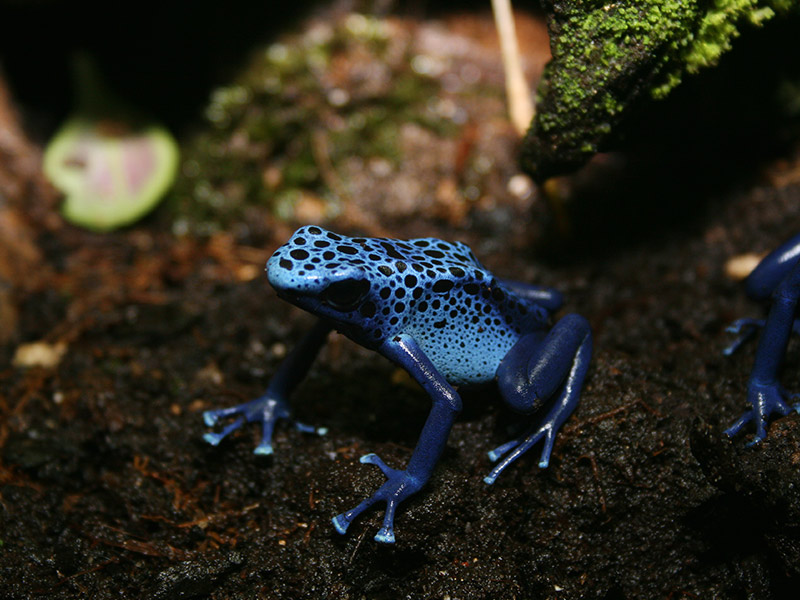
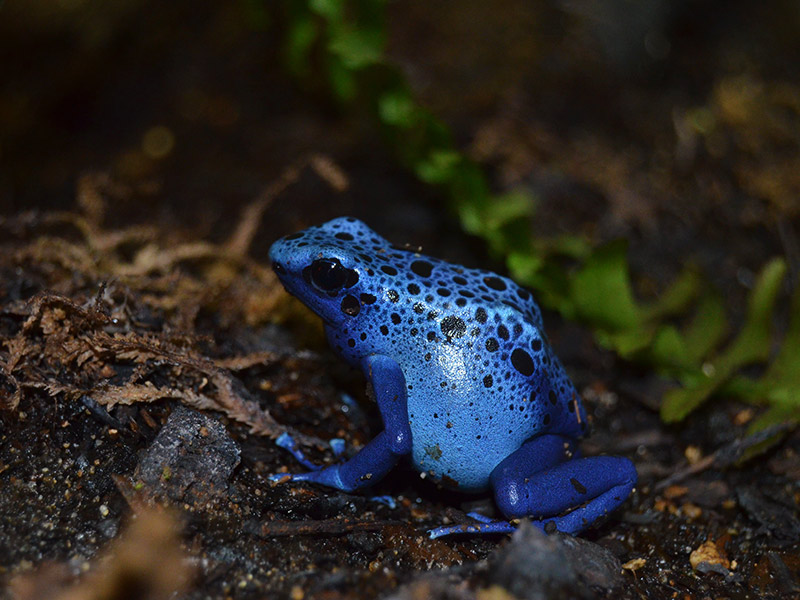
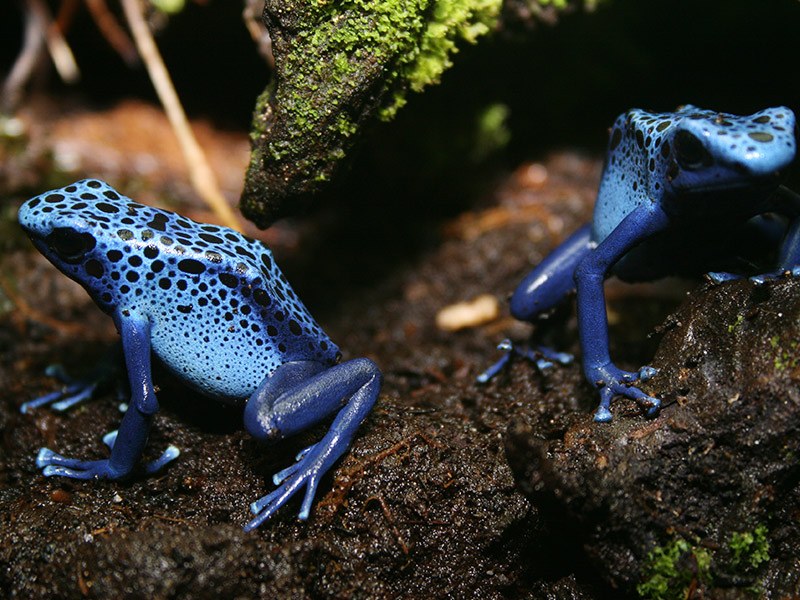
The dyeing poison frog (Dendrobates tinctorius or Dendrobates azureus) is one of the world’s most striking amphibians thanks to its spectacular bright blue colouring, speckled with black spots that are unique to each individual, allowing them to be identified in much the same way as a fingerprint. Furthermore, as is the case with other species in the animal kingdom, this striking appearance acts as a warning signal to predators, indicating that their skin contains toxic substances.
In the dyeing poison frog, the toxicity stems from compounds it obtains whilst feeding in its natural habitat, mainly on small arthropods; consequently, specimens kept in captivity tend to lose much of this toxicity as they do not consume the same prey as they would in the wild. The common name ‘poison dart frog’ originates from the fact that certain indigenous peoples of South America used it to coat the hunting darts of their blowpipes. Although the blue poison dart frog belongs to this group, it was not one of the species most commonly used for this purpose, as other frogs, such as the golden poison frog (Phyllobates terribilis), possess far more potent toxins.
This species inhabits a very specific area in southern Suriname, on the northern coast of South America, where it lives in small tropical forests surrounded by the Sipaliwini savannah. It prefers warm, humid environments, usually near streams, roots, fallen logs and moss-covered rocks. Although it is capable of climbing, it spends much of its time on the forest floor foraging for food.
The dyeing poison frog is diurnal, notable for its high activity levels during the day and its territorial behaviour, particularly during the breeding season. Furthermore, the males play an important role in parental care: the males guard the eggs and, after hatching, carry the tadpoles on their backs to small pools of water where they complete their development.
The dyeing poison frog plays a vital role in the tropical ecosystems where it lives. As a predator of small insects and other invertebrates, it contributes to the natural balance of the forest and forms part of complex food webs. Furthermore, as with many amphibians, its presence is an excellent indicator of environmental health, as these animals are particularly sensitive to changes in water quality, temperature or humidity.
Although this species is not currently among the most threatened in its family, amphibians constitute one of the most vulnerable groups of vertebrates on the planet. More than a third of known species are threatened due to habitat destruction, pollution, climate change, the emergence of diseases such as chytridiomycosis, and the introduction of invasive species.
Specifically, the main threats to the dyeing poison frog include the loss and fragmentation of tropical forests, the degradation of its natural environment, fires and illegal capture for the exotic animal trade. The protection of Suriname’s rainforests is essential to ensure the survival of this species and the rich biodiversity that shares its habitat.