If you come in costume, you get free admission! Get it here.
Important information: Due to technical adjustments, the main pool will be temporarily out of activities.

Book our Unique Experiences online!

Interactions with sea lions, penguins, giant tortoises, monkeys,... and much more! All the information here.

Serrated casquehead iguana

Theme area:  Amazonía
Scientific name:  Laemanctus serratus
Class:  Reptiles
Continent:
,  North America
,  Central America and the Caribbean
Habitat:  tropical forests, jungles and rainforests
Diet:  insects, spiders and small invertebrates
Weight:  around 225 grams
Size:  entre 50 y 75 cm, incluyendo su larga cola

altphoto

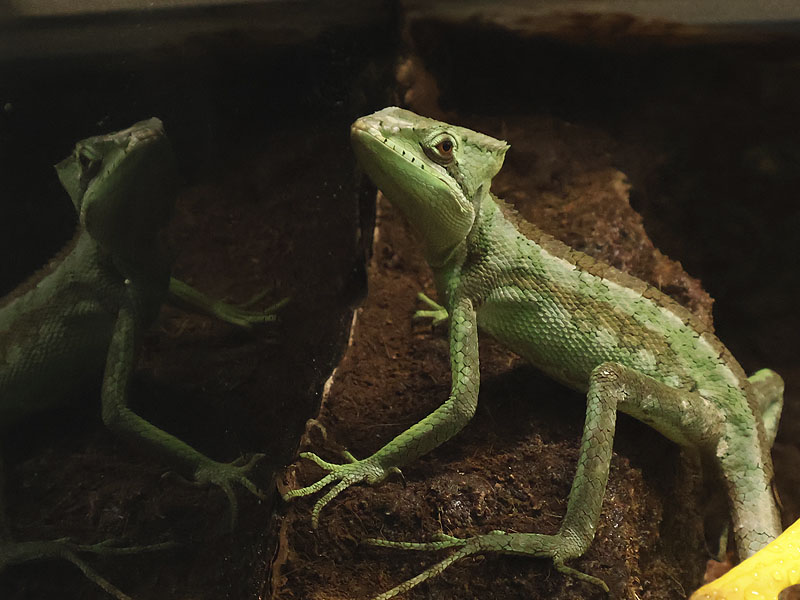
The serrated casquehead iguana, or serrated-crested iguana, also known as the crowned toloque (Laemanctus serratus), is a reptile belonging to the Corytophanidae family. It is distinguished by the striking helmet-shaped crest on its head and its elegant colouring, which can vary between shades of green and brown to help it blend into the vegetation.

The serrated casquehead iguana is found in south-eastern Mexico and in several Central American countries, such as Belize, Guatemala and Honduras. It lives mainly in dry and humid tropical forests, where it spends much of its time on branches and tree trunks thanks to its arboreal habits. It is a diurnal animal that moves with great agility through the vegetation in search of food and shelter.

A prehistoric-looking tree lizard

The distinctive skull of the serrated casquehead iguana, formed by enlarged scales, and its sawtooth-shaped dorsal crest give it a unique appearance amongst American lizards. Another of its most striking features is its ability to change colour relatively quickly, shifting from intense shades of green to brown tones depending on environmental conditions or its state of alertness. This adaptation helps it to evade predators and remain unnoticed in its surroundings.

It contributes to the natural balance of the ecosystems it inhabits, as it feeds mainly on insects and other small invertebrates. Its discreet behaviour and excellent camouflage mean that, despite being widely distributed, it is difficult to spot in the wild.

Ecological importance and threats in its native habitat

The serrated casquehead iguana plays an important role in the forest ecosystems of Central America, as it helps to control insect populations whilst itself serving as prey for birds and snakes, amongst other predators. As a result, it forms part of the complex food web that maintains the balance of tropical forests.

The conservation of the tropical ecosystems in which it lives is essential to ensure the survival of this unique species and of many others that depend on these natural environments. Globally, it is a species at low risk of extinction, due to its wide geographical distribution and the fact that its populations are considered stable across much of the range it occupies. However, the serrated casquehead iguana faces local threats arising from habitat loss and fragmentation caused by agricultural expansion, livestock farming and forest conversion. 

Conservation Status
Extinct
Extinct in the wild
Critically endangered
Endangered
Vulnerable
Near threatened
Least concern
Insufficient data
Not evaluated

DID YOU KNOW ...

it is one of the lizards best adapted to life in trees? Its excellent camouflage helps it to stay hidden and find food.
FROM 2 YEARS
Family enjoying the Penguin Encounter at Selwo Marina
Penguin Encounter

Penguin Encounter

Online tickets from

€17.90

€15.90