If you come in costume, you get free admission! Get it here.
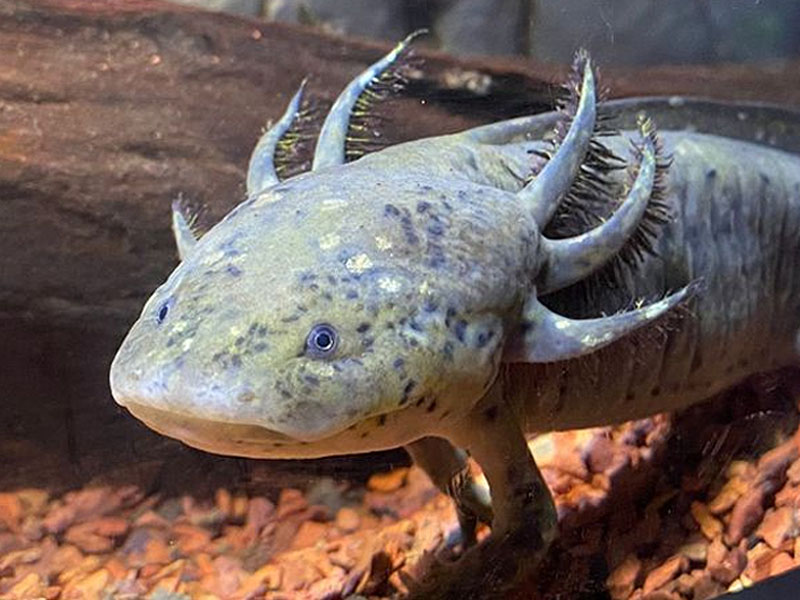
The axolotl (Ambystoma mexicanum), also known as the ‘Mexican walking fish’, is an amphibian endemic to Mexico and one of the most unique species on the planet. Although it belongs to the salamander family, unlike most salamanders, it retains characteristics typical of the larval stage throughout its life, such as its striking feather-like external gills and its entirely aquatic lifestyle. It can grow to between 20 and 30 centimetres in length and has a broad head, small eyes and a long tail adapted for swimming.
In the wild, the axolotl lives exclusively in the canals and wetlands of Xochimilco, south of Mexico City, and is classified as critically endangered, with populations that have been severely depleted due to habitat loss. It once inhabited other lakes in the Valley of Mexico as well, but the urbanisation of these ecosystems has drastically reduced its natural range. It prefers calm, cold waters with abundant aquatic vegetation, where it finds shelter and food.
As well as its endearing appearance, the axolotl is famous worldwide for its extraordinary ability to regenerate. It can regrow entire limbs, parts of the spinal cord, heart tissue and even regions of the brain without leaving any significant scars. This ability has made the species a key organism for scientific and biomedical research.
Another of its most surprising characteristics is neoteny, a biological phenomenon whereby it reaches sexual maturity without completing the metamorphosis typical of other amphibians. As a result, it retains its external gills and remains in the water throughout its life.
In addition to its scientific importance, the axolotl has been part of Mexico’s cultural heritage since pre-Hispanic times. Its name derives from the Nahuatl word āxōlōtl and is linked to ancient legends and traditions that have made it one of Mexico’s most iconic animals.
The axolotl plays a vital role in the aquatic ecosystems of Xochimilco. As a predator of small invertebrates, larvae and insects, it helps to maintain the balance of food chains and contributes to the health of the wetlands where it lives. Furthermore, its presence serves as an indicator of the ecosystem’s environmental quality, as it depends on clean, well-preserved waters.
The axolotl is currently listed as Critically Endangered by the International Union for Conservation of Nature (IUCN). Its wild populations have suffered a sharp decline due to the loss and degradation of its natural habitat. Among the main threats affecting the species are the urbanisation of wetlands, water pollution, the reduction of natural areas, and the introduction of invasive species such as carp and tilapia, which compete for resources and prey on eggs and juveniles. As a result, numerous conservation programmes are currently working to restore the Xochimilco canals and protect the wild populations of this extraordinary amphibian.